Showing posts with label travel. Show all posts

Monday, August 22, 2011

Marvels of Canada


The Canoe, Ontario

The Peterborough Canoe Museum

My paddle clean and bright,
Flashing with silver.
Follow the wild goose flight,
Dip, dip and swing.

This is the familiar refrain of an old canoeing song, and what better than the canoe to stand for everything Canadian? The canoe has slipped quietly into the stream of the nation’s common parlance. Whether you’re practicing your J-Stroke out on the lake, rooting for your favourite professional soccer team in the national Voyageurs Cup, or simply standing at the corner of Portage and Main in Winnipeg, you are reflecting a bit of Canadian canoeing history. Canoes take many forms: from the slick lines of a racing canoe, to the ruggedness of a seagoing cedar canoe, from cleverly assembled birch bark, to the shiny fiberglass, or the comfy inflatable. Early explorers and voyageurs took their cue from the Aboriginal peoples of Canada, utilizing the canoe as the most versatile and reliable mode of transportation. We received many nominations making this important historical link between the establishment of European culture and industry in Canada, and the canoe.  Furthermore, if it weren’t for the humble canoe, half the wonders on this list would be inaccessible!


Niagara Falls, Ontario

Niagara Falls
NIAGARA FALLS! Stupendous, beautiful,
Enduring monument of the Power Divine!
Thy white-foam pillars ever moving stand,
And ever standing move harmoniously
To the rough music of the dashing spray,
And roaring tumult of thy boiling base.
- From “Niagara Falls: A Poem in Three Cantos’ by James K. Liston, 1843.
Born around 12,000 years ago, Niagara Falls is a set of massive waterfalls located on the Niagara River, on the border between Canada and the United States.
The Falls are comprised of three separate waterfalls: the Horseshoe Falls, the American Falls, and the smaller, adjacent Bridal Veil Falls.  The crescent-shaped Horseshoe Falls is also known as the Canadian Falls as it is located mostly on the Canadian side of the border.
The residents of Niagara Falls were among the most passionate and vocal participants in the 7 Wonders of Canada project. After appearing on Sounds Like Canada and The National, Westlane Secondary student Becky Puddicombe became a local celebrity, receiving a job offer from the Niagara Parks Commission and the Key to the City from the mayor. One opinion piece in the Niagara Falls Review newspaper compared the CBC’s selection process to the 2004 presidential election in Florida.


Pier 21, Halifax, Nova Scotia
Pier 21
From the late twenties to the early seventies, Pier 21 was Canada’s ‘front door’ to over a million immigrants, refugees, troops, wartime evacuees, war brides and their children. It has been compared to New York’s Ellis Island, and is intrinsically linked to  Canada’s multicultural national identity. In 1999 the building at Pier 21was refurbished and reopened, to pay tribute to those who had passed through its doors, enriching our cultural landscape immeasurably. Now Canada’s last surviving ocean immigration shed, Pier 21 explores a key part of our heritage through interactive exhibits, multimedia presentations and activities for all ages. Pier 21 hopes to officially become a National Museum, telling the story of immigration and nation-building to all Canadians.


The Rockies, British Columbia / Alberta
The Rockies
This Wonder of Canada almost speaks for itself. From the brilliant blue of Lake Louise, the Valley of the Ten Peaks, towering Mount Robson, Moraine Lake, not to mention the gorgeous Banff Springs Hotel… all these magnificent jewels set brilliantly in one, whopping “wonder.” The Canadian Rockies are distinct from the American Rockies as they have been been very heavily glaciated, resulting in sharply pointed mountains separated by wide, U-shaped valleys gouged by glaciers, whereas the American Rockies are more rounded. That’s why, even though the Rocky Mountain Range runs from Northern British Columbia to New Mexico, we can claim our very own “Rockies” as a distinct wonder of Canada. 


The Igloo, Northern Canada
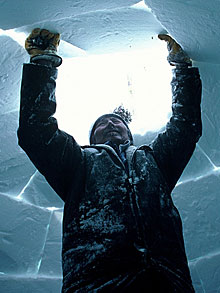
The Igloo
Photo Courtesy Nunavut Tourism
The igloo is an iconic structure recognized around the world. At once beautiful and strong, simple yet complex, the architecture of an igloo represents an ingenious use of nature’s materials to suit human needs.
An igloo (Inuit language: iglu) or "snow house" is a shelter constructed from blocks of snow, generally in the form of a dome. Although igloos are mainly associated with the Inuit people of Canada’s Arctic (as well as being found in Greenland), they are also part of the common Canadian identity. After all - even putting aside the occasional jokes about Canadians living in igloos – many children around the country have at some point tried making their own igloo-like structure in the winter.
It’s been decades since igloos were a common form of housing for the Inuit, but traditionally, they ranged in size from small, one-person overnight shelters to large ceremonial complexes linked by smaller igloos.
The igloo is renowned for its spiral dome and ability to protect those inside from the cold. The dome’s blocks are cut diagonally with a snow knife or rip saw, and gently slope inward toward the top of the roof. As for warmth, a well-built igloo with a soapstone lamp could bring the temperature up to around 0° C when it’s –40° C outside. Add a little body heat to the equation, and you’re perfectly comfortable.


Old Quebec City, Quebec

Old Quebec City
Quebec City is the capital of Quebec and, after Montreal, the second largest city in the province. Quebec's Old Town (Vieux-Québec) is the only North American fortified city north of Mexico whose walls still exist. It was declared a UNESCO World Heritage Site in 1985, as the "Historic District of Old Quebec". Founded in the early 17th century by French explorer Samuel de Champlain, la vielle capitale celebrates its 400th anniversary in 2008, and its history shows. In Quebec’s Upper and Lower Towns, above and below the cliff, you can find at least 11 architectural styles, ranging from Classical Revival (1790-1820) to International Style (1930-1965). The area is also home to the Plains of Abraham, where a pivotal battle between the French and English in 1759 shaped the future of North America.


Prairie Sky, Canadian Prairies
Prairie Sky
Vast, brooding, or uncannily blue, the “Big Sky” of the Canadian prairies has been nominated over and over again, in different ways, as one of the true wonders of Canada.


Related Story:
Wonder World - Galapagos Islands
Northernmost settlement of the world


SponsoredTweets referral badge Get Chitika Premium

Join me on the New Digg

CLICK HERE FOR MORE INTERESTING STORIES
Follow verseilie on Twitter loading...

Saturday, June 18, 2011

Lost World!

North America is home to numerous important archaeological sites, some dating as far back as 10,000 B.C. But what exactly makes a site significant in North America? 

We have awe-inspiring pyramids and lost cities that were built by manly societies without the aid of metal tools, beasts of burden or even the wheel. You can also walk the same trails that Icelandic Vikings once did. Do we have your attention now?

You know that many of these are World Heritage Sites and protected by the international community. So while access to these places is permitted -- usually for a small fee or donation -- please respect them. Plan ahead, as a few sites are only open during certain seasons. Last of all, no pot hunting!


Teotihuacan (200 B.C. To A.D. 650)

Just 30 miles northeast of Mexico City is the Mesoamerican site of Teotihuacan, the oldest on our list, which descends in order of age. Once the largest urban center in North America, by A.D. 500, Teotihuacan even rivaled the ancient city of Rome. Though there are many architectural sites to see here, your trip would not be complete if you did not walk down the Calzada de los Muertos (Avenue of the Dead) and climb to the top of the Pyramid of the Sun, the world’s third largest pyramid, and the Pyramid of the Moon.


Palenque (100 B.C. To A.D. 800)

While you’re in Mexico, Palenque is also a must see. Considered by many to be the country’s most breathtaking archaeological site, the Mayan city of Palenque is located in the state of Chiapas. Here you will discover incredible architecture that includes several important Mayan temples. Excavations are still ongoing at Palenque, so you may even get a chance to see archaeologists in action if you time your trip right. A museum is also located on site and contains several of Palenque’s ancient artifacts.


Mesa Verde (A.D. 600 To A.D. 1300)

Head to the Four Corners, where Utah, Colorado, New Mexico, and Arizona meet, and you’ll find Mesa Verde National Park. Near Cortez, Colorado, it is far from being your everyday national park. Mesa Verde is home to more than 4,000 known archaeological sites, among them some 600-plus cliff dwellings of the ancestral Pueblo people. And don’t forget to hike up to the top of the mesa to explore the Sun Temple.


Cahokia (A.D. 600 To A.D. 1400)

The remains of the prehistoric city of Cahokia, which was established about the same time as the dwellings in Mesa Verde, sit a few miles west of Collinsville, Illinois, next to the Mississippi River. Archaeologists believe that Cahokia is the largest prehistoric urban center of the Mississippian Culture -- even larger than 11th-century London. This ancient settlement is home to several earthen mounds, including the Monks Mound, the largest earthwork north of Mexico. Another point of interest is Woodhenge. Many believe the prehistoric inhabitants of Cahokia used this archaeological feature as an astronomical calendar to monitor the seasons.


Chaco Canyon (A.D. 900 To A.D. 1150)
One of the most significant and impressive archaeological remains in North America can be discovered in New Mexico’s Chaco Canyon. Surrounded by mountains and mesas, your inner archaeologist will be awoken as you travel on backcountry trails that will lead you to remote Chacoan sites, ancient roads, rock art, and prehistoric stairways.

L’Anse Aux Meadows (A.D. 1000)

Contact between the peoples of the New World and the Old World is generally associated with Christopher Columbus, overshadowing a lesser-known date (by about 500 years) of historical importance when a group of Icelandic Vikings landed in what is today Newfoundland, Canada. It is on this island where the oldest known European settlement in North America is located. Founded around A.D. 1000, the archaeological site of L’Anse Aux Meadows revealed a small community, including houses, several workshops and a small forge, where iron was smelted in the New World for the first time.

Serpent Mound (A.D. 1070)

I had you at Serpent, didn’t I? And with good reason: Peebles, Ohio is home to the “largest surviving example of a prehistoric effigy mound in the world,” the Serpent Mound. Stretching 1,348 feet over the ground, the beautifully preserved ancient earthwork depicts the form of a moving serpent with an oval shape at the head. What purpose it served is still a mystery, but many prehistoric peoples occupied this area for thousands of years prior to European contact, and remnants of their sophisticated art and large-scale earthen creations, such as the Serpent Mound, still remain.

Tulum (A.D. 1200 To A.D. 1450)

We return to Mexico, 80 miles south of Cancun, to take in the archaeological site of Tulum. Constructed by the Maya shortly before the arrival of Europeans, Tulum is believed by archaeologists to have been a fort built to watch the sea. Walk through the site and marvel at monumental architecture, such as El Castillo, the Temple of the Descending God and the Temple of Frescoes.


Roanoke Colony (A.D. 1585)

Back in the States, near the town of Manteo, North Carolina, is what many consider to be one of the world’s greatest mysteries. The Roanoke Colony, also known as the "lost colony," is where 116 men, women and children, including two that were born in the New World, vanished without a trace. Theories explaining the disappearance of the colonists abound, including starvation, a massacre and even an alien encounter. A visit to Roanoke Colony is definitely worth the trip. And who knows -- maybe you will find a clue that sheds light on this bizarre occurrence.

Pointe-A-Calliere

Venture across the Canadian border, and you’ll find the Pointe-a-Calliere museum, a unique destination and archaeological treasure trove located in the heart of Old Montreal. Named after the third governor of Montreal, Chevalier Louis Hector de Calliere (he built his house on this spot in 1688), Pointe-a-Calliere offers a journey through more than 1,000 years of human activity that include remarkable architectural remains and an archaeological crypt located below the city, all of which are displayed in situ (archaeology jargon for “left in place”). A visit to this location will also showcase the origins of Montreal’s distinct urban landscape and fascinating history.

Well, that’s more than 2,000 years of history covered by just 10 North American destinations. And this is just a small sampling of what can be found relatively close to home. So, dust off your fedora and set off on your own archaeological adventures, right here in your own backyard. Just leave your whip at home.


Get Chitika Premium


CLICK HERE FOR MORE INTERESTING STORIES
Follow verseilie on Twitter

Friday, June 17, 2011

Bavarian Forest

 The Bavarian Forest (German:  Bayerischer Wald ) is a wooded low-mountain region in Bavaria, Germany. It extends along the Czech border and is continued on the Czech side by the Šumava (Bohemian Forest). Geographically the Bavarian Forest and Bohemian Forest are sections of the same mountain range. A part of the Bavarian Forest belongs to the Bavarian Forest National Park(Nationalpark Bayerischer Wald) (240 km²), established in 1970 as the first national park in Germany. Another 3008 km² belong to the Bavarian Forest Nature Park(Naturpark Bayerischer Wald), established 1967, and 1738 km² to the Eastern Bavarian Forest Nature Park (Naturpark Oberer Bayerischer Wald), established 1965. The Bavarian Forest is a remnant of the Hercynian Forest that stretched across southern Germania in Roman times. It is the largest protected forest area in central Europe.
The highest mountain in the region is the Großer Arber ("Great Arber", 1456 m). The main river is the Regen, which is formed by the conjunction of White Regen and Black Regen and leaves the mountains towards the city of Regensburg


Get Chitika Premium


CLICK HERE FOR MORE INTERESTING STORIES
Follow verseilie on Twitter